
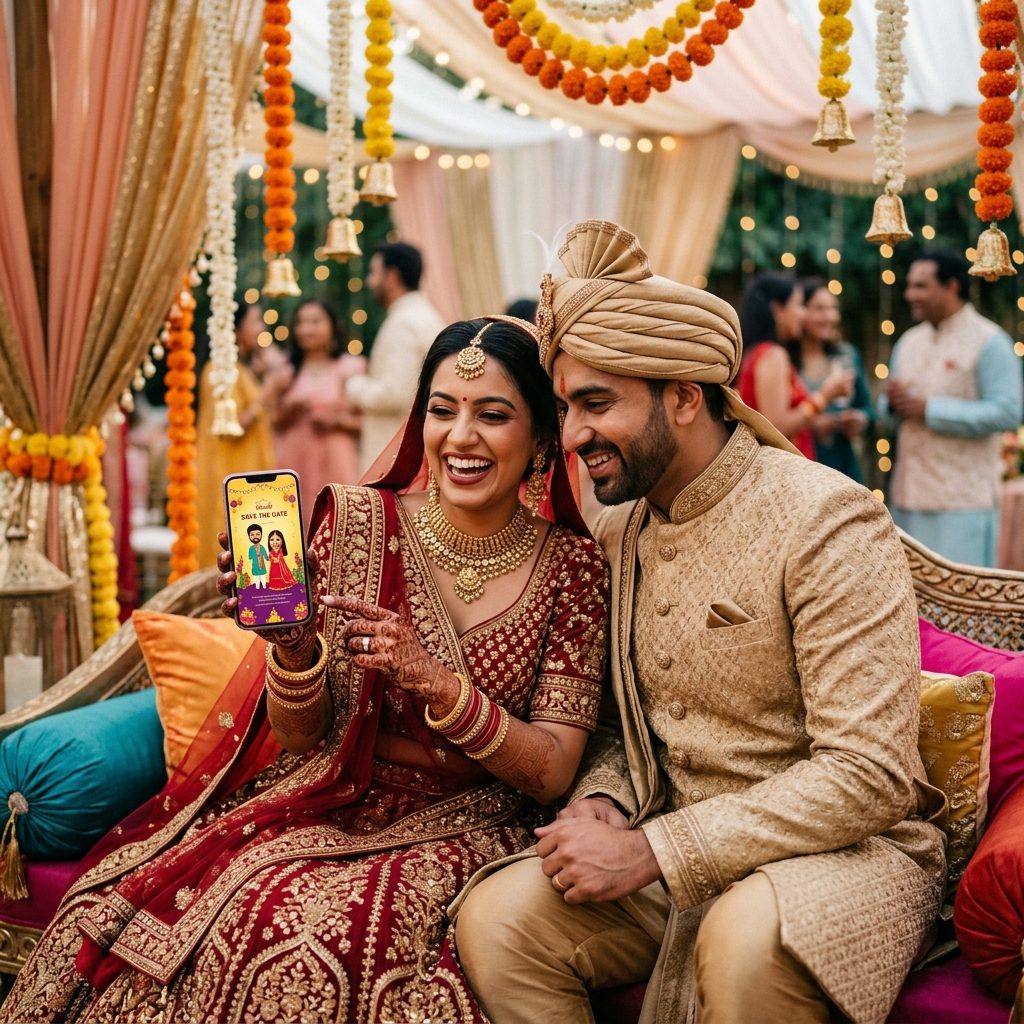
Your bua in Indore got the wedding news the same way she gets everything now - as a forwarded video on the family WhatsApp group. Ninety seconds of dhol, your cousins' names dissolving into rose petals, the date glowing in gold. She watched it twice and booked her train ticket before the printed card would have even reached her colony. That, in one scene, is why an animated video invitation has quietly become the most-shared part of an Indian shaadi. Not the venue. Not the menu. The invite itself, traveling at the speed of a forward.
The printed card isn't dead. But for the first announcement - the one that decides who actually shows up - the digital wedding invitation has won, simply because it moves, it plays music, and it slides into the one app every relative already has open.
So why did video invitations suddenly take over?
Short answer: distribution. A box of 300 printed cards reaches 300 addresses, slowly, by hand or courier, and half of them never confirm. A video invitation reaches 3,000 phones the moment your mother forwards it to the building group, the office group, and the maternal-side cousins' group. One tap to watch, one tap to add to calendar, one tap to RSVP.
The cost gap is brutal too. A decent printed card set with gold foil and an inner liner can run you well past what families expect. A polished animated invite costs a fraction of that and looks like something a film studio made. For destination weddings - a Marwari sangeet in Udaipur, a beach phera in Goa - the maps, dress code, and event timeline can all live inside one shareable link instead of three folded inserts nobody reads.
Doesn't a video feel less personal than a real card in hand?
Short answer: the opposite, when it's done right. A good video invitation can carry your actual engagement photos, your voices saying "save the date," the real Choghadiya muhurat time, and the exact ceremonies in order - haldi Thursday, mehndi Friday, sangeet Saturday. A printed card can fit a fraction of that.
The trick is restraint. The weddings that get the most replays aren't the ones drowning in stock-template glitter. They're the ones that feel like the couple. A Bengali invite that opens with the conch and "Subho Bibaho," a Tamil Iyer one that leads with the kalyana mandapam and the groom's gotra, a Punjabi one set to a live shehnai loop - those land because they're specific. You can build exactly that kind of personal, motion-led card in our Invite Studio, picking the template, the accent colour, the music, and the ceremony list yourself.
What actually makes a video invite get forwarded (and not muted)?
Short answer: the first three seconds and the music. People decide whether to watch in the time it takes a reel to autoplay. If your invite opens with the names and a hook beat, it survives. If it opens with ten seconds of an empty floral border, thumbs scroll past.
The best wedding invitation isn't the one that looks the most expensive - it's the one your relatives can't stop forwarding.
Here's what separates a video your guests replay from one they silently archive:
- Lead with the names and the date in the first 5 seconds - never make people wait through an intro animation to learn whose wedding it is.
- Keep it under 90 seconds. Anything longer gets paused and never resumed. One ceremony list, one venue, one muhurat - not your whole life story.
- Pick music that matches the side of the family - traditional shehnai for the elders' group, a punchy sangeet track for the cousins' group. Many couples make two cuts of the same invite for exactly this.
- Make the date tappable. A built-in "add to calendar" button quietly fixes the biggest RSVP problem - guests who meant to come and forgot.
- Add a countdown for destination weddings so out-of-town relatives feel the clock and book travel early instead of three days before.
- End with a clear RSVP link, not just a phone number. The easier it is to reply, the more accurate your headcount.
How do video invitations fix the RSVP nightmare every family knows?
Short answer: they turn a guessing game into a list. With paper cards, you call 80 households, half say "haan haan aa rahe hain," and you still over-cater by 100 plates out of sheer fear. A digital wedding invitation with a built-in reply button gives you a real, running count - who's coming, who's plus-one, who needs a veg thali.
That single number changes everything downstream. Catering, room blocks, the shagun envelope estimate, the seating chart. Once the replies start landing, our Guest Manager lets you track confirmations, group families together, and chase the cousins who opened the invite but never tapped reply. The same headcount that used to take your father two weeks of phone calls now updates itself as the forwards spread.
Is the printed card finished, then?
Short answer: no - but its job has shrunk. The video does the inviting now. The printed card has become a keepsake: the heavy, gold-foiled piece you hand to the boy's family in person, the one grandparents frame, the one that goes into the wedding album. Smart families do both - the animated invite for reach and RSVPs, the printed card for the elders and the few relationships that genuinely need ink and paper.
And the digital format is only getting richer. Couples now embed the love story, the location map, even a private link to how they first matched for the ones who love that story. The invite has stopped being a one-way announcement and become a small interactive page about your wedding.
If you're sending out word for a shaadi this season, start with the format your relatives will actually watch and forward. Sketch your ceremony timeline, pick a track that sounds like your family, and build your animated video invitation first - the printed cards can follow for the few who'll treasure them. Your bua in Indore is waiting to forward it. Give her something worth tapping twice.