
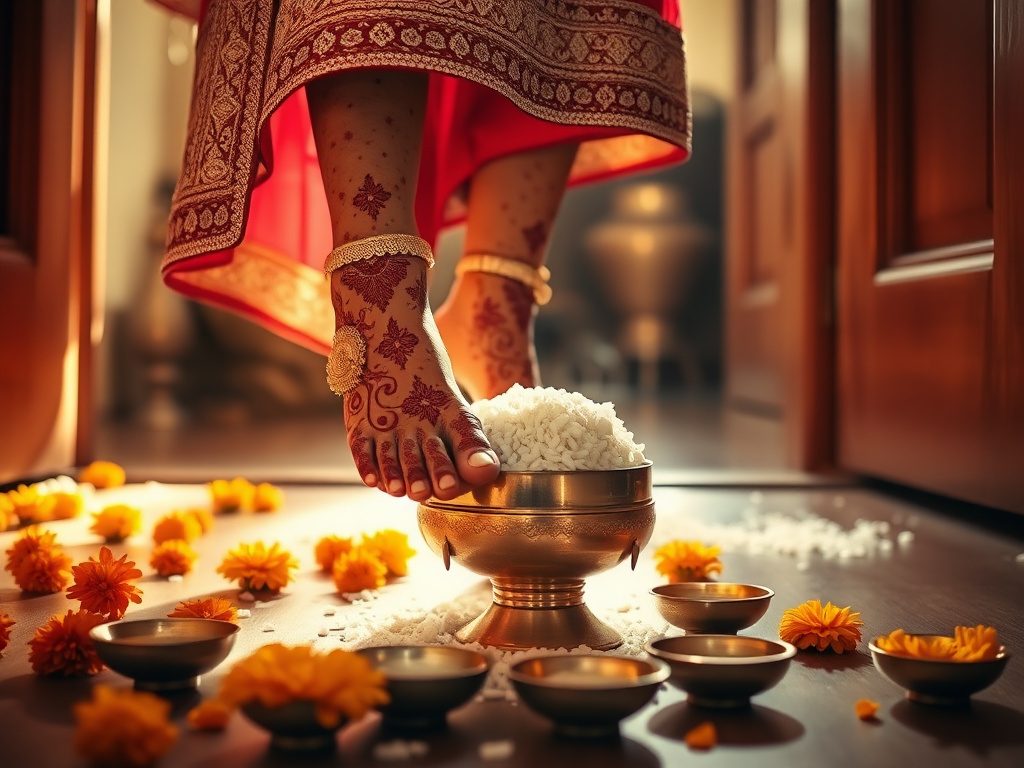
The wedding ceremony may end at the mandap, but for a bride, the journey into her new life truly begins at the threshold of her marital home. The Griha Pravesh, or the formal welcoming of the bride, is one of the most sentimental and culturally rich rituals in Indian weddings. It represents the official transition of the bride from her parental home to her husband’s family, where she is received not just as a daughter-in-law, but as the living embodiment of Goddess Lakshmi, bringing prosperity, joy, and light.
The Symbolism of the Threshold and the Rice Kalash
The most iconic image of a Griha Pravesh is the bride gently tipping over a copper or brass pot (kalash) filled to the brim with raw rice using her right foot. Across India, the right foot is associated with auspiciousness, righteousness, and positive energy. Tipping the rice symbolizes the overflowing wealth and sustenance she brings into the household. As she steps across the threshold, she dips her feet in a plate of wet vermilion (kumkum) or red dye (alta) and walks on a white runner, leaving behind her footprints. These red footprints are treated as the permanent blessings of Lakshmi, a physical reminder of the day auspiciousness walked into the house.
Regional Variations Across India
While the core essence remains the same, the rituals change beautifully across different states. In West Bengal, the ceremony is known as Bodhu Boron, where the mother-in-law welcomes the bride by touching her forehead with a bamboo sieve (kula), looking at her face through a lamp, and feeding her sweets. In Maharashtra, the groom's mother or sister ties a sacred thread on the bride's wrist and does an aarti before she enters. A fun Maharashtrian ritual involves the bride stepping on a measured pile of rice grains to enter, followed by the changing of her name, symbolizing her new identity. Down south, the Grahapravesham is often marked by boiling milk in the kitchen until it overflows, signaling a lifetime of abundance and happiness for the new family.
A daughter-in-law is not a guest entering a household; she is the foundation upon which the future of the family is built, bringing grace and continuity to our ancient lineage.
Essential Preparation for the Ritual
To ensure the ceremony proceeds smoothly without last-minute stress, families should prepare the necessary items beforehand. A traditional welcome requires meticulous planning of both spiritual and material elements. Here is a checklist of essentials for the Griha Pravesh:
- A brass or copper Kalash filled with high-quality raw rice grains.
- A wide brass plate filled with a mixture of Alta or Kumkum water.
- A clean, white cotton or paper runner laid out from the entrance to the prayer room.
- An Aarti thali containing a burning camphor diya, vermilion, turmeric, and flowers.
- A small sweet to feed the newlyweds at the door.
Building Family Bonds After the Welcome
Once the formal religious rites are completed, the atmosphere transitions from solemn to playful. Traditional ice-breaking games, like finding a gold ring submerged in a bowl of milk and rose petals, help ease the bride's nervousness and foster early bonds with her new family. These lighthearted moments are essential for making her feel comfortable and loved in her new surroundings.
Every beautiful Indian wedding starts with finding the right life partner and ensuring cosmic alignment. If you are preparing to start your own journey toward these sacred family traditions, you can create a beautifully formatted matrimonial profile today using the Shubh Muhrat Biodata Maker to find a compatible partner who shares your cultural values.