
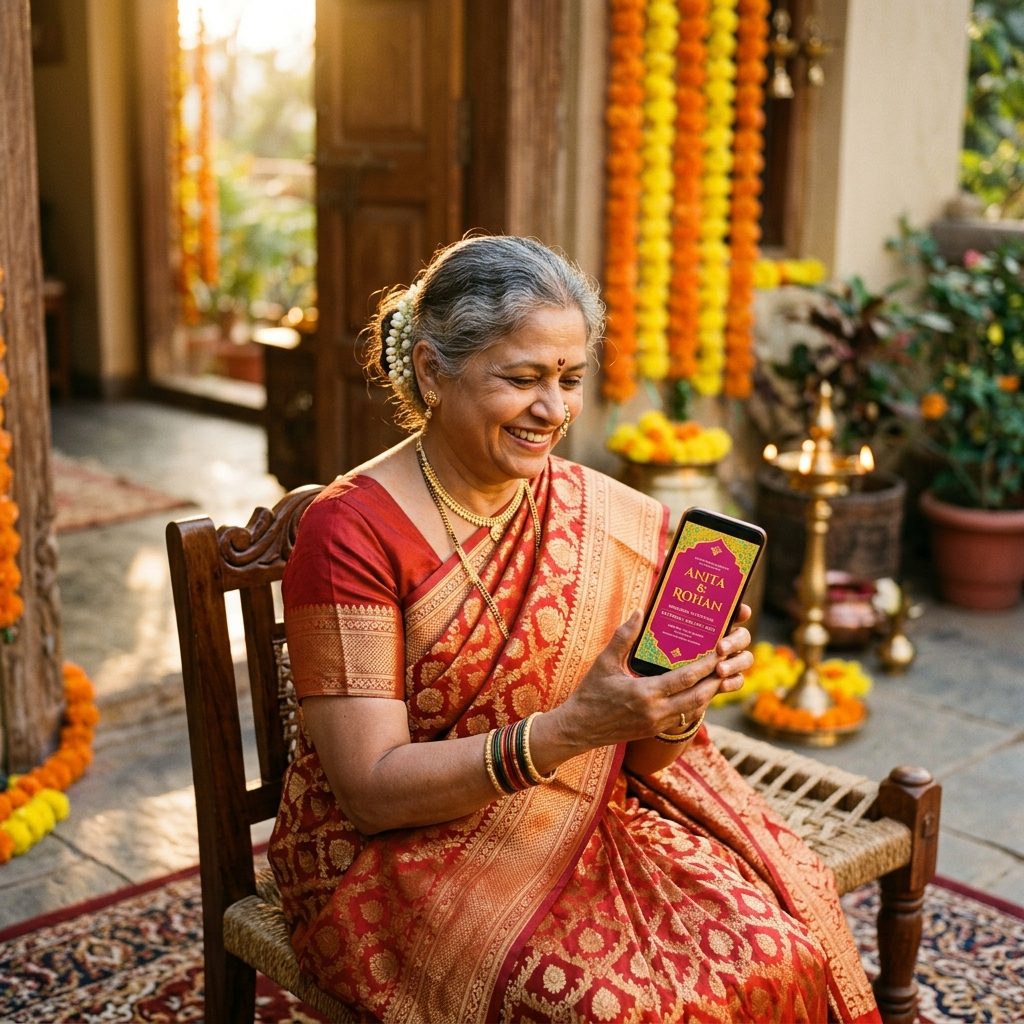
Your wedding card is going to land in a WhatsApp chat between a Good Morning flower GIF and a forwarded message about turmeric curing everything. That's the real competition. A great WhatsApp wedding invitation isn't about being pretty - it's about surviving the scroll, getting saved, and pulling a reply. Most families send a flat JPEG nobody opens twice. You're about to do it better, and you can build the whole thing in minutes.
Why is everyone ditching the printed card for WhatsApp?
Short answer: speed, money, and the simple fact that your cousin in Dubai opens her phone before she opens her post box. A printed card for 300 guests can run ₹40,000 to ₹1.5 lakh once you add foil, boxes, and courier. A digital invite reaches the same 300 people - plus the 80 you forgot - by tonight.
But here's what families get wrong. They treat the digital invitation like a cheaper printout. It isn't. WhatsApp is a conversation, not a postbox. A Marwari family I know sent a 9:16 video invite that opened with the dhol and closed with a tap-to-RSVP button. Forty replies in an hour. Their printed cards, sent the same week, got maybe six phone calls. Same guests. Different medium, different result.
What actually counts as a good WhatsApp wedding invitation?
Short answer: vertical, fast, and built for a thumb. Your guests are holding a phone in one hand, usually standing in a kitchen or a metro. A wide landscape card shrinks to a postage stamp in the chat preview. A tall 9:16 design fills the screen and looks made for the phone - because it is.
Three formats win on WhatsApp, and each does a different job:
- The e-card (static): one clean vertical image with names, date, venue, and the muhurat time. Best for the formal first wave - elders, neighbours, the boss.
- The video invite: 20 to 40 seconds with motion, music, and your photo. This is the one that gets forwarded to the whole khaandaan group.
- The save-the-date: a teaser sent weeks early so the Bengaluru and overseas crowd can book leave and flights before fares climb.
You don't have to pick one. The smart families send a save-the-date in month one, the e-card for the formal invite, and the video the week of the function to spike the excitement. You can build all three from one design in our wedding Invite Studio without touching a single design app.
A printed card gets admired for ten seconds and stacked in a drawer. A WhatsApp invite gets forwarded to people you never even had the address for.
How do I make a WhatsApp invite that doesn't look cheap?
Short answer: respect the rituals and the regional flavour, and the design carries itself. The fastest way to look cheap is to use a generic template that could belong to any wedding in the world. The fastest way to look classy is specificity.
An Iyer wedding card names the muhurtham and the kalyana mandapam; a Punjabi one might lead with the Anand Karaj and the night before's sangeet; a Bengali invite carries the gaye holud and often the bride's family name in the warm red-and-white of a Tant saree. Put the right ritual names in. Use the colours your community actually weds in - the Marwari reds and golds, the Nair gold-and-cream, the Reddy temple palette. A guest reading it should feel it was written for your family, not pulled off a shelf.
One more thing people forget: legibility. Tiny cursive fonts look elegant on a laptop and become unreadable mush on a 6-inch screen held by your 70-year-old mama. If your father can't read the venue at arm's length, the design failed, however gorgeous it is.
How do I track who's actually coming after I hit send?
Short answer: this is where digital quietly destroys paper. With a printed card you're calling 300 people one by one, scribbling "yes / maybe / no" on the back of an envelope. With a digital invite you can add a tap-to-RSVP and watch the list build itself.
That headcount is not a small thing. Your caterer needs it for the dinner count, the decorator needs it for seating, and your mother needs it to know whether to add another row of chairs. Instead of chasing replies across six different chats, keep one clean list - which is exactly what a guest list and RSVP manager is for. Confirmed numbers, dietary notes, the kids count, table groupings. When the thank-you notes go out after the wedding, that same list does the work again.
What are the mistakes that get a WhatsApp invite ignored?
Short answer: sending it wrong, not designing it wrong. A beautiful invite can still flop on delivery. Here's what trips families up - and what to do instead:
- Dumping it in a group of 200. Big-group sends feel like a mass forward. The formal invitations - elders, in-laws-to-be, close family - deserve a personal one-to-one message with their name in the first line.
- Sending a giant file. A 30 MB video makes people wait, and people don't wait. Keep video invites short and compressed so they play the instant they're tapped.
- No clear date or venue in the caption. Many people read the chat text and never open the image. Put the date, city, and venue in plain words in the message itself.
- Forgetting the location pin. Attach a Google Maps pin for the venue. Half your no-shows are really got-lost-and-gave-ups.
- Sending once and going silent. One invite three weeks out, one gentle reminder the week of. That's a nudge, not nagging.
- No way to reply. If guests have to call to confirm, most won't. Give them a one-tap RSVP.
If your wedding is also where two families first connect, the same warmth that makes a good invite makes a good first impression - the same instinct that helps people find compatible matches and write a real first message instead of a copy-paste. Tone matters everywhere in a wedding.
Start with one strong vertical design, write the muhurat and venue clearly into the caption, send the formal invites personally, and let an RSVP button do the chasing for you. Build your WhatsApp wedding invitation today, send the save-the-date tonight, and give your guests something they'll actually open, save, and reply to - which, after all, is the whole point of an invitation.