
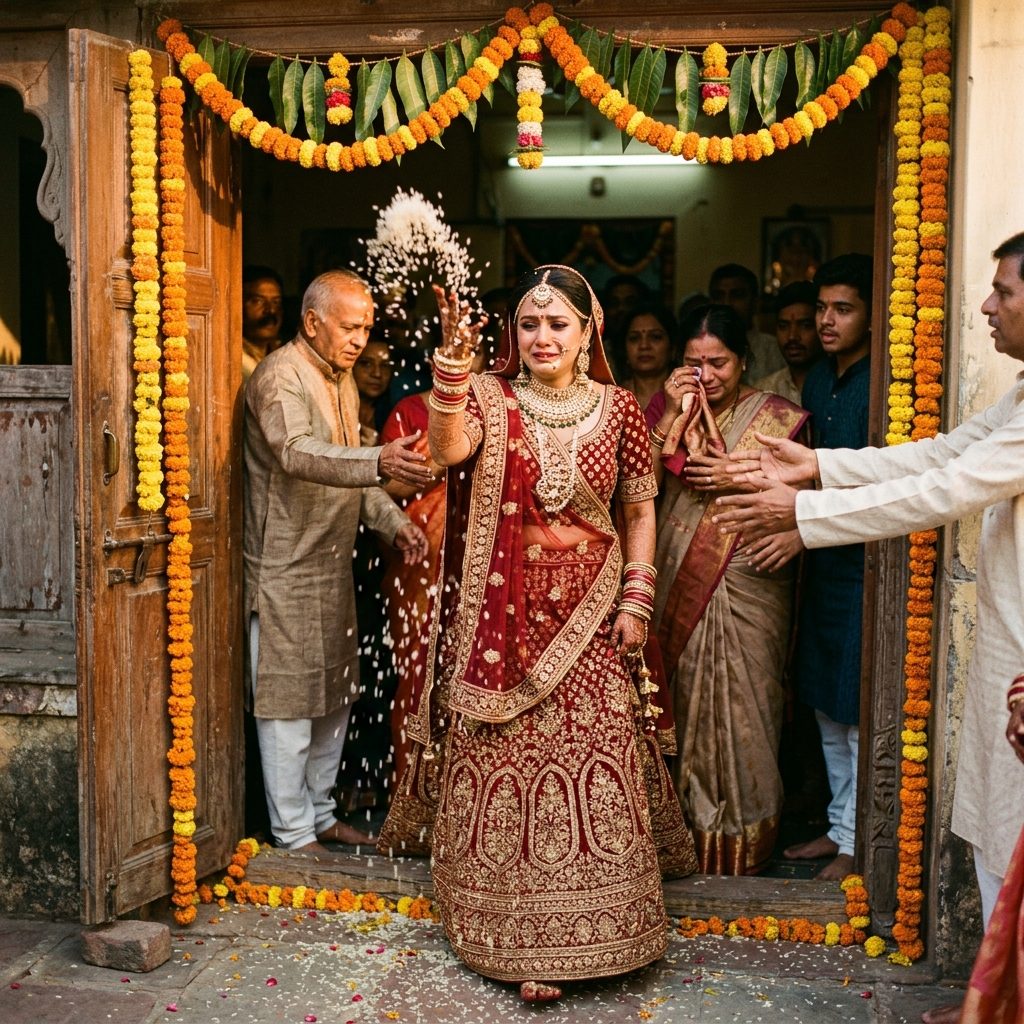
The handful of rice a bride throws backwards over her head as she leaves isn't a good-luck charm. It's a goodbye and a thank-you packed into one gesture - she's symbolically repaying her parents for everything they poured into her, and wishing the house she's leaving will never go hungry. That single moment is the emotional core of Vidaai rituals, the Indian wedding farewell where the daughter formally steps out of the home she grew up in. If you've ever wondered why the whole family suddenly dissolves into tears at the happiest event of the year, this is why.
Vidaai (also spelled bidaai) is the bittersweet bridge between two families. The mandap was the celebration. This is the consequence.
What actually happens during a Vidaai ceremony?
Short answer: a daughter walks out one door and into a new life, and her family performs small, ancient acts to bless that walk.
The newly married couple steps out of the bride's family home or the wedding venue. The bride pauses at the threshold. Behind her stand the people who named her, fed her, and argued with her over curfews. In front of her waits the car - and a different surname. The rituals fill that gap between the two.
The most recognised act is the rice-throwing: the bride scoops handfuls of rice and coins, often mixed, and flings them back over her shoulders without turning around. Her family catches what they can in a dupatta or cloth. The meaning is layered - prosperity left behind for the parental home, gratitude for a lifetime of nourishment, and the wish that her absence won't bring scarcity.
Then comes the car. In North Indian and Punjabi families, the brothers and cousins push the vehicle a few feet by hand before the engine takes over - a quiet promise that her family is the one setting her on the road. Many fathers and brothers walk alongside the car until it turns the corner.
Why does everyone cry at a Vidaai - even people who barely know the bride?
Short answer: because for one honest minute, the wedding stops pretending it's only joyful.
Indian weddings are loud with sangeet, mehendi, and three days of feasting. The kanyadaan earlier in the ceremony - the giving away of the daughter - is solemn but still ritualistic. Vidaai is where the abstraction becomes a physical fact. The girl who slept down the hall last night will sleep in another city tonight.
A wedding is a celebration of a beginning. The Vidaai is the only part that's honest about the ending.
Mothers who held it together through every other ritual break here. Fathers who never cry, cry. And the bride - who may have chosen this match herself, who may be genuinely thrilled - still weeps, because joy and grief are not opposites in a family home. They're roommates.
Are Vidaai customs the same across India?
Not even close. The emotion is universal; the choreography is wildly regional.
In Punjabi and Marwari weddings, the rice-throwing and the car-push are central, often with a phulon ki chadar (a canopy of flowers) held over the couple as they exit. In Bengali homes, the bride throws back fistfuls of rice and durba grass while the entire household sheds tears, and there's a particular weight given to the moment she covers her face. Among Tamil Iyer and Iyengar families, the farewell tends to be quieter and more scripture-anchored, woven into the larger sequence rather than staged as a single dramatic exit.
South Indian Reddy and Nair weddings frame the departure differently again - the matrilineal threads in some Kerala communities historically softened the sharpness of a girl 'leaving forever.' Gujarati families often add playful pre-Vidaai games, so the laughter and the tears arrive almost in the same breath.
Here's the honest myth-bust most families won't say aloud: the Vidaai is not supposed to be a funeral. Somewhere along the way, the more a bride sobs, the more 'devoted' she's assumed to be, and that's quietly cruel. A daughter can love her parents fiercely and still be excited to go. Tears measure attachment, not obligation. The families who get this right let the bride feel whatever she actually feels.
How do modern couples make Vidaai meaningful instead of just heavy?
Short answer: keep the symbol, drop the performance.
Couples today are reshaping the farewell so it honours the tradition without forcing anyone into theatrical grief. Some brides walk out smiling and come back next week. Some grooms join their in-laws in the rice ritual, signalling that no one is being 'taken.' And because the two families are now genuinely merging rather than one surrendering a daughter, the planning starts long before the threshold.
- Check the deeper compatibility first. Before the rituals, many families still run the horoscopes - you can do a proper guna milan and kundli match to look at rashi, nakshatra and manglik alignment, so the Vidaai feels like a confident send-off, not a gamble.
- Brief your photographer for the threshold. Ask for the rice-over-the-shoulder frame and the father's face - those are the photos families keep for forty years.
- Let the bride set the tone. If she wants a dry-eyed, beaming exit, protect that. Don't let aunties script her grief.
- Make the exit logistics calm. Decide in advance who walks with the car and where it stops, so the moment isn't ruined by a parking argument.
- Send a warm send-off message. A heartfelt digital note or a shared wedding e-card or video invite from the couple thanking both families lands beautifully right after the Vidaai.
- Keep one small object from home. Brides who carry a single token - a mother's bangle, a grandmother's sari pin - report the transition feels gentler.
What does the Vidaai really mean for the family left behind?
Short answer: it's a graduation, not a loss - though it rarely feels that way at 4 pm on the wedding day.
For the parents, the empty room the next morning is the loudest part of the whole celebration. But the tradition was never about losing a daughter; it was about trusting her enough to let her build something of her own. The rice she threw back was a gift - a way of saying the home that made her will always have abundance.
And for couples just beginning this story, the work of finding the right person to walk that threshold with is its own journey. Whether your match comes through family, friends, or a quiet search for someone genuinely compatible across values and stars, the Vidaai will mean far more when the partner waiting in that car is truly yours.
If a wedding is on your horizon, sit with the meaning of Vidaai before the day arrives - talk to your daughter, your son, your parents about what this farewell should feel like. The rituals are old, but the choice of how to honour them is yours. Make it gentle, make it true, and let the rice fly.