
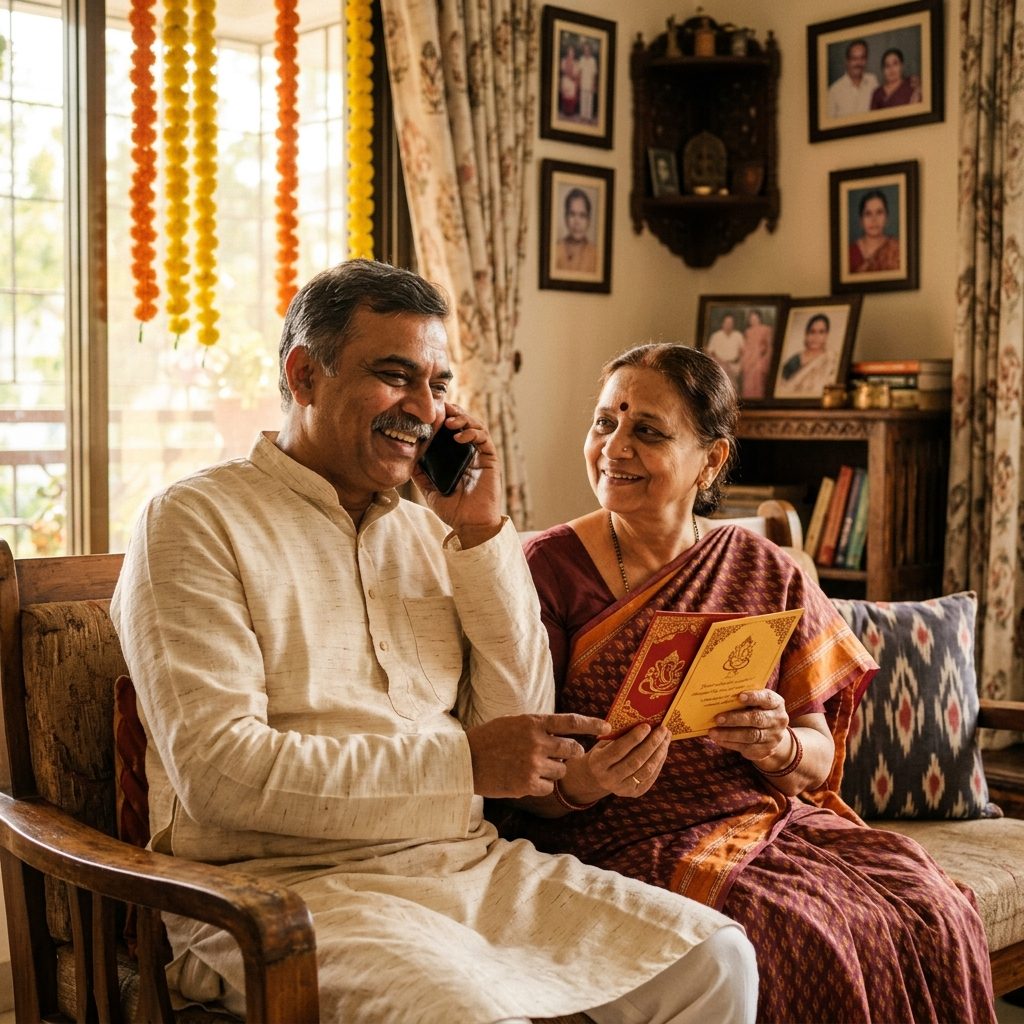
Your Tau ji has not replied to the wedding card. You sent a polite WhatsApp three days ago. Silence. Now you're stuck on the single most awkward task of the whole shaadi: sending RSVP reminders to elders without sounding like you're badgering them for a yes-or-no. Short answer first - in most Indian families, an elder's silence is not a no, and it is almost never a confirmation either. It just means the message went to a relative who reads WhatsApp like it's a museum exhibit. The graceful fix is rarely a louder text. It's usually a phone call from the right person.
Why won't elders just reply to the RSVP?
Because to most of our parents and grandparents, an invitation is a relationship, not a calendar event. A younger cousin sees "RSVP by 10th" and taps a button. A 68-year-old Marwari uncle sees that same line and thinks: of course I'm coming, why are they asking me like a stranger? The very act of asking can feel cold. He shows up. He just never told you.
Then there's the tech gap. Many elders read WhatsApp but don't reply to it - they'll see your message, nod at the phone, and move on. Some have the chat open in their head and assume that counts. A Bengali thakuma might wait to discuss it with her son before committing. A Reddy patriarch may treat it as a matter for the whole household, not a personal yes. None of this is rudeness. It's a different grammar of invitation, and your reminder has to speak it.
How do I send a reminder without it sounding rude?
Stop reminding. Start including. The trick is to reframe the nudge as fresh news instead of a chase. "Just confirming you got our card" sounds like an audit. "Tau ji, the haldi is the morning of the 14th and we really want you in the front - shall I keep your seat with the family?" sounds like love. Same goal, opposite feeling.
Give them a job, not a form. Elders respond beautifully when you ask for their blessing or their presence at a specific ritual - the kanyadaan, the milni, the var mala. "We can't do the milni without you standing for our side" will get a faster yes than any deadline ever could. You're not collecting a headcount. You're handing them a role in the family story.
An elder's silence after a wedding invite is rarely a no. It's usually a yes that nobody taught them how to type.
WhatsApp, a call, or someone in person - which actually works?
Short answer: match the channel to the elder, never the other way round. A blanket WhatsApp blast is fine for cousins your age. For the senior generation, here's the order that actually lands:
- The right voice does the work. A reminder from the groom's father to his own elder brother lands as respect; the same words from a 22-year-old grandnephew can read as cheeky. Route each reminder through the closest-in-status family member.
- Call, don't text, for the 70-plus crowd. Two minutes on the phone settles what five unanswered messages cannot. Open with their health, close with the date - the RSVP slips out naturally in between.
- Use the card as the reminder. A printed save-the-date or a tasteful video invite re-shared once feels like an honour, not a poke. If you haven't sent something they can hold or proudly forward, build one in our wedding invitation studio and let the design do the gentle reminding.
- Send the reminder through their child. The fastest path to a Chacha's confirmation is often a quiet word to his daughter. She'll get the answer in one dinner conversation.
- Anchor it to a ritual, not a deadline. "Sangeet is at 7, your favourite cousins will all be there" beats "please RSVP by Friday" every single time.
- Confirm dietary and travel needs in the same breath. Asking "shall I arrange your pickup from the station?" is a reminder disguised as care - and it gets you the yes you needed.
What's the one mistake families make with elder RSVPs?
Here's my honest take, and it'll sting a little: most families treat the elders' RSVP as an afterthought and the youngsters' as the real project. It should be the reverse. Your college friends will reply in an hour and turn up regardless. It's the Mama from Indore, the Dadi who can't travel alone, the Pishi who needs a ground-floor room - those are the confirmations that quietly decide whether your wedding feels full of family or full of acquaintances. When you let elder follow-ups drift to the last week, you're not saving time. You're risking the exact people whose absence you'll feel at the mandap.
The second mistake is letting one person hold all of it in their head. Aunt counts on her fingers, uncle has a different list, and by the wedding week nobody actually knows who said yes. Keeping every confirmation, dietary note, and travel detail in one shared place - a proper guest list and RSVP tracker instead of scattered chats and a paper diary - is the difference between calm follow-ups and a frantic scramble two days before the haldi.
How do I follow up after the wedding without nagging?
The reminders don't end at the mandap - and this is where families forget their elders entirely. A handwritten note or a warm voice message to every senior who blessed your union closes the circle with grace. "Dada, having you give us your aashirwad meant everything" is a sentence that gets repeated at family gatherings for years.
Keep your thank-you list organised the same way you kept your confirmations - one tidy record so no elder is missed and no gift goes unacknowledged. If the wedding is also the start of a wider family search for a cousin or sibling still looking, you'll already have a sense of which relatives are warm and well-connected; some families even quietly begin to discover compatible profiles once the celebration energy is high.
Sending RSVP reminders to elders is never really about the headcount. It's about making the oldest people in your family feel essential rather than processed. Pick the right voice, offer them a role instead of a deadline, and keep every confirmation in one place. Do that, and the front row at your wedding will be full of exactly the faces you hoped to see - blessing you, not just attending you. Make those calls this week, and let the rest of the planning take care of itself.