
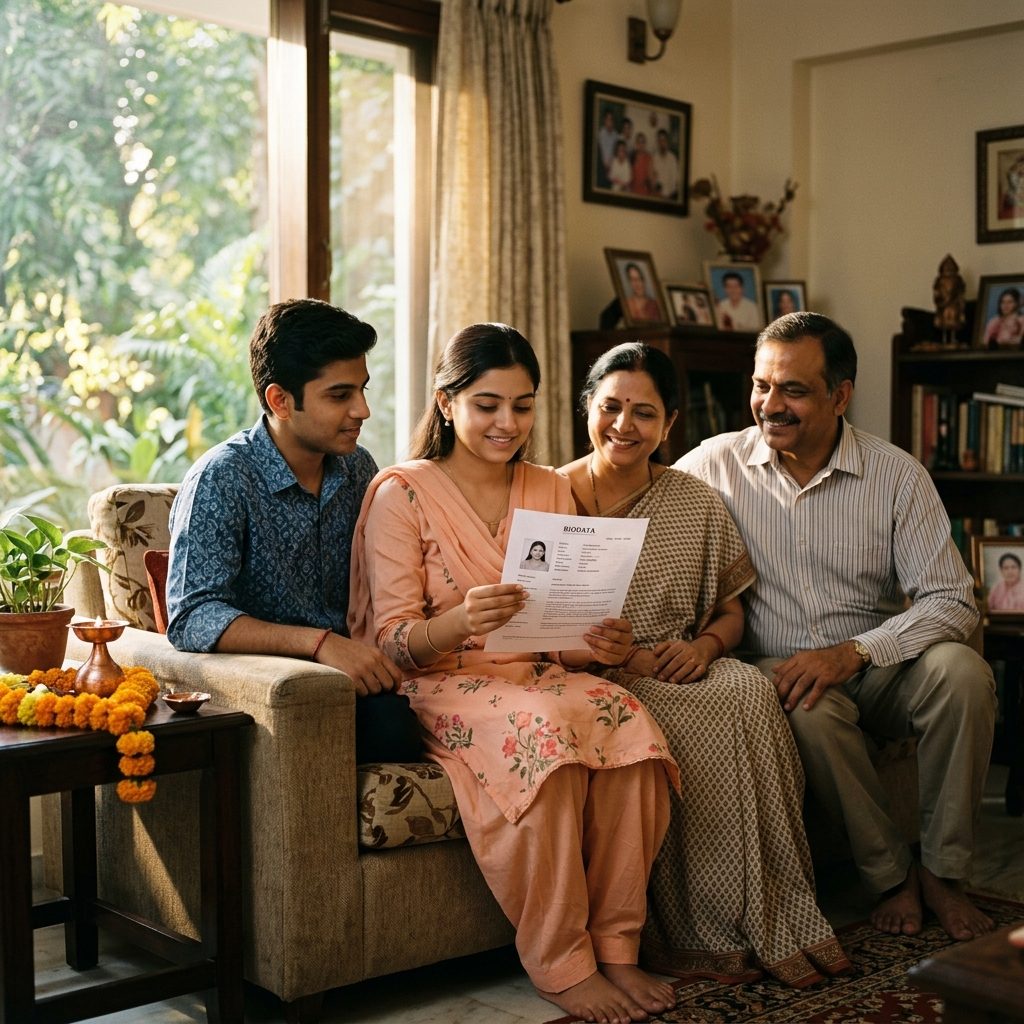
A marriage biodata is not a resume with a horoscope stapled to the back. People treat the two as cousins, copy-paste their job profile, swap "Career Objective" for "About Me," and wonder why the rishta aunties go quiet. The truth in the resume vs. biodata debate is simpler and stranger than most families assume: one is selling your output, the other is introducing your household. Get that wrong and the most accomplished candidate can still read like a spreadsheet.
So before you send that PDF to a single prospect, let's settle what actually separates a marriage biodata from a job resume, and what each one is quietly asking the reader to decide.
So what is the real difference between a resume and a biodata?
Short answer: a resume answers "Can this person do the job?" A marriage biodata answers "Can our two families live alongside each other?"
A resume is a one-person document. It is ruthless about relevance, every line earns its place by proving competence, and anything older than your last role gets cut. A biodata is a family document dressed as a personal one. It opens with you, yes, but it spends real estate on your father's occupation, your mother's background, your siblings, your gotra or community, sometimes your native place going back two generations.
That is not padding. In a Tamil Iyer match or a Marwari alliance, the family section is often read first, before the reader even gets to your education. A recruiter does not care who your father is. A prospective mother-in-law absolutely does.
Why does copying my resume into a biodata backfire?
Because tone is content. A resume is built on power verbs, "spearheaded," "optimised," "drove revenue," and that language sounds like a performance review, not a person you'd share a kitchen with.
Here is the part most families get wrong, and I'll say it plainly:
The resume sells what you achieved. The biodata reveals who you are when no one is paying you to perform.
A biodata wants steadiness, warmth, and a sense of the everyday you. "Senior Manager, leading a team of 14" belongs on a resume. "Works as a senior manager; loves cooking on Sundays and is close to her grandparents" belongs on a biodata. Same person. Completely different invitation. One says hire me, the other says know me.
And length cuts the opposite way. A resume fights to stay on one or two pages. A good marriage biodata is also one to two pages, but it earns that space with detail a recruiter would slash, height, complexion if your community expects it, diet (pure veg, eggetarian, non-veg), hobbies that hint at temperament, and partner expectations stated honestly rather than buried.
What should a biodata include that a resume never would?
Short answer: the human and the household, the stuff a hiring manager would find irrelevant and a family finds essential. When you're building yours, weight these the way the reader will:
- Family details that go deep: father's and mother's occupation, siblings and their marital status, native place, and community. In a Bengali or Reddy match this can decide the first call.
- Astrological essentials: rashi, nakshatra, gotra, manglik status, and date/time/place of birth, so the other side can run guna milan before anyone meets.
- A warm "About Me" in first or third person: three or four honest lines about temperament and values, not a career objective.
- Lifestyle markers: diet, languages spoken, religious practice level, willingness to relocate, joint vs. nuclear preference.
- A genuine, recent photo: a clear face shot in good light, not a cropped wedding picture or a sunglasses selfie. This single line does more lifting than any achievement bullet.
- Honest partner expectations: two or three lines on what you're looking for, stated kindly, so the wrong matches self-filter out early.
If listing all of that on a clean page sounds like a chore, our AI biodata maker handles the formatting, the religious header symbol, and the photo placement for you, so you fill in the details and it lays them out the way Indian families actually expect to read them.
Does the photo and design really matter that much?
Short answer: more than your designation does.
A resume is text-first; a photo on a resume is often a liability. A biodata is the reverse, the photo and the visual header carry serious emotional weight. A Ganesh or Om symbol at the top, a soft traditional border, a portrait where you look approachable, these signal respect for the process and warmth toward the family reading it. A wall of grey text, no photo, and a corporate font tells the other side you treated your own marriage like a job application. They notice.
This is also where the two documents split on durability. You write one resume and reuse it for fifty companies. A biodata you'll happily tailor, a little more astrology for a traditional household, a little more career detail for a metro-city techie family. Same core, different emphasis, because you're not applying to a company, you're hoping to fit into a family.
How do I actually get from job-profile to marriage-ready?
Short answer: start from the family and the human, not the career. List your parents, siblings, community, and birth details first. Then write four warm lines about who you are off the clock. Only after that do you add education and work, trimmed to a line or two, because here it's context, not the headline.
Once your biodata feels right, the document is only step one. The harder part is finding people whose values and family background actually align with yours, which is why a lot of families now skip the endless WhatsApp forwards and look at compatible profiles on Smart Match where the same details you just organised, community, diet, expectations, do the early filtering for you. And when a match does work out, that's when you graduate to the genuinely fun paperwork, like designing the wedding invitations and save-the-dates for the day itself.
So treat the resume vs. biodata distinction as the first real decision of your matchmaking, not a formatting afterthought. A resume gets you a job. A thoughtful marriage biodata, warm, honest, family-aware, gets you a fair shot at the right person and spares you a hundred mismatched conversations. Build it like you mean it, and let the document do the quiet introducing before you ever pick up the phone.