
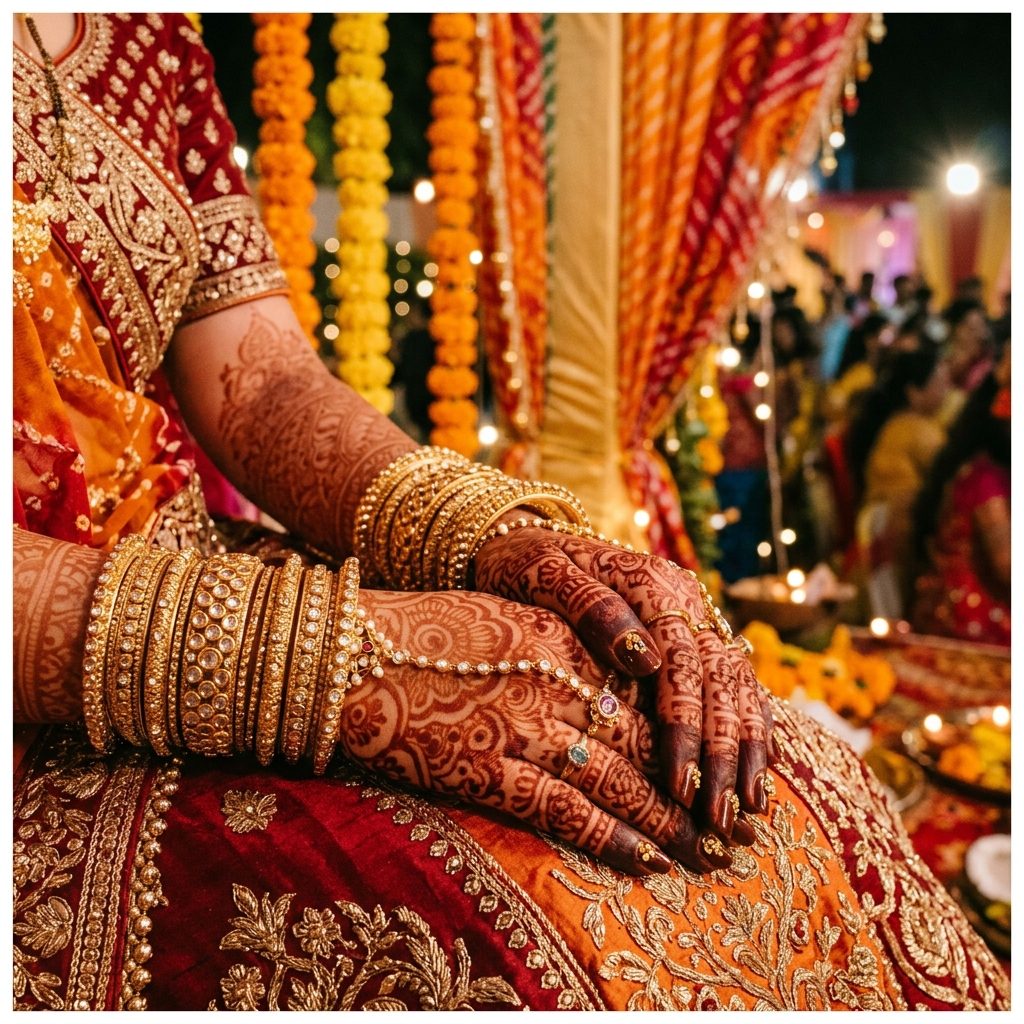
The darker the mehendi, the more your husband loves you. You've heard it. It's also nonsense - the colour depends on your skin's keratin and how long you left the paste on, not on anyone's feelings. But that single sentence is exactly why regional mehendi traditions in India are worth understanding properly. Behind every swirl of henna sits a different community, a different ceremony, and a different idea of what the bride's hands are supposed to say to the family she's marrying into.
So before your wedding henna ritual gets reduced to an Instagram reel, let's walk through how a Marwari bride, a Bengali bride, and a Nair bride each wear it - because they really do not wear it the same way.
Why is North Indian mehendi so dense and detailed?
Short answer: because in Rajasthan and the Punjab, the bridal henna design is meant to cover, not decorate. A Marwari or Punjabi bride's hands and feet are loaded almost edge to edge - fine paisleys, jharokha arches, peacocks, and the groom's name hidden somewhere in the pattern for him to hunt down on the wedding night.
The Rajasthani style leans into mirror-image symmetry and the classic "gol tikki" centre on the palm. Punjabi mehendi runs heavier on dense floral nets and often climbs well past the elbow. In both, a pale or patchy stain is read - unfairly - as bad luck, which is why the paste sits on for six to eight hours and gets sealed with a lemon-sugar dab.
Here's the honest opinion most families won't say out loud: the obsession with darkness has quietly turned a joyful ritual into a stress test for brides. The colour is chemistry. The meaning is yours to assign.
Mehendi was never a beauty contest. It's a love letter your community helps you write in henna - the darkness is just the ink reacting, not a verdict on your marriage.
What makes South Indian henna so different?
Short answer: it's lighter, more geometric, and historically it wasn't even henna in some homes. Tamil Iyer and Iyengar weddings traditionally used maruthani - henna applied as simple solid tips or a single filled circle on the palm, not the lacy North Indian net. A Nair bride in Kerala often kept it minimal, sometimes just reddened fingertips, because the focus there sat on the jasmine in her hair and her kasavu saree.
Andhra and Telangana Reddy weddings sit somewhere in between - cleaner motifs, more open space, mango and lotus shapes rather than wall-to-wall coverage. The South Indian bridal mehendi philosophy is restraint: let the gold and the silk do the talking, and let the henna be a quiet accent.
If you're marrying across regions - a Punjabi bride into a Reddy family, say - this is genuinely worth a conversation early. Families read these visual cues. Knowing how your in-laws expect henna to look is the same small homework as knowing what to put on a thoughtful marriage biodata: the details signal that you've actually paid attention to who they are.
How do Bengali, Marwari, and Gujarati rituals compare?
Short answer: same plant, wildly different ceremony around it. A few real differences worth knowing:
- Bengali: mehendi is light and often secondary - the headline ritual is gaye holud, the turmeric ceremony, where the bride glows yellow before anyone thinks about henna.
- Marwari & Rajasthani: the mehndi ki raat is a full event with dholki, folk songs, and the densest bridal coverage of any community in India.
- Gujarati: henna pairs with garba, so the night is as much about dancing as about the design; motifs often include peacocks and the sun.
- Maharashtrian: traditionally restrained - simple round patterns, with the green bangles and nath getting more attention than elaborate henna.
- Sindhi & Khatri: rich, layered designs close to the Marwari style, usually applied a clear day before the wedding so the stain peaks on the right morning.
Notice the pattern: the henna almost never stands alone. It's stitched into a larger pre-wedding evening - songs, food, the women of both families finally meeting properly. That social glue is the real ritual.
Does the mehendi ceremony actually mean anything anymore?
Short answer: more than the design ever did. Strip away the motifs and the mehendi night is the one evening where the bride's side and groom's side mingle informally before the formal wedding pressure begins. Aunts gossip. Cousins choreograph. Someone cries. It's the original ice-breaker - which is exactly the role a good first conversation plays when two families are still circling each other.
That's also why so many modern couples now meet long before the henna cones come out. Whether the introduction happened through a cousin, a community contact, or a curated platform where you can find genuinely compatible profiles in your community, the mehendi night is where that match stops being a profile and becomes a person surrounded by your people.
And if your families still weigh tradition heavily, the henna evening usually arrives after the horoscopes have been read - so it helps to have already sorted the kundli and guna milan compatibility well before the celebration calendar fills up.
How do you choose a mehendi style that's truly yours?
Short answer: start from your community, then bend the rules on purpose. A few specific, non-filler tips:
- Ask your grandmother what motif her generation used - revive one real heritage element instead of copying a Pinterest design wholesale.
- Book a trial 10-15 days before the wedding; your stain colour and skin reaction will tell you everything.
- If you're mixing regions, split the difference - dense North-style palms, lighter South-style forearms.
- Hide a meaningful word, not just the groom's name - a place, a date, an inside joke.
- Leave the paste on overnight wrapped in tissue; never scrape it, only let it flake.
The best mehendi isn't the darkest or the most intricate. It's the one that tells your specific story - your community, your family, the marriage you're actually building. Get the symbolism right and the colour stops mattering. So learn your regional mehendi traditions, pick the elements that mean something to you, and let your hands carry a little of where you come from into where you're going next.