
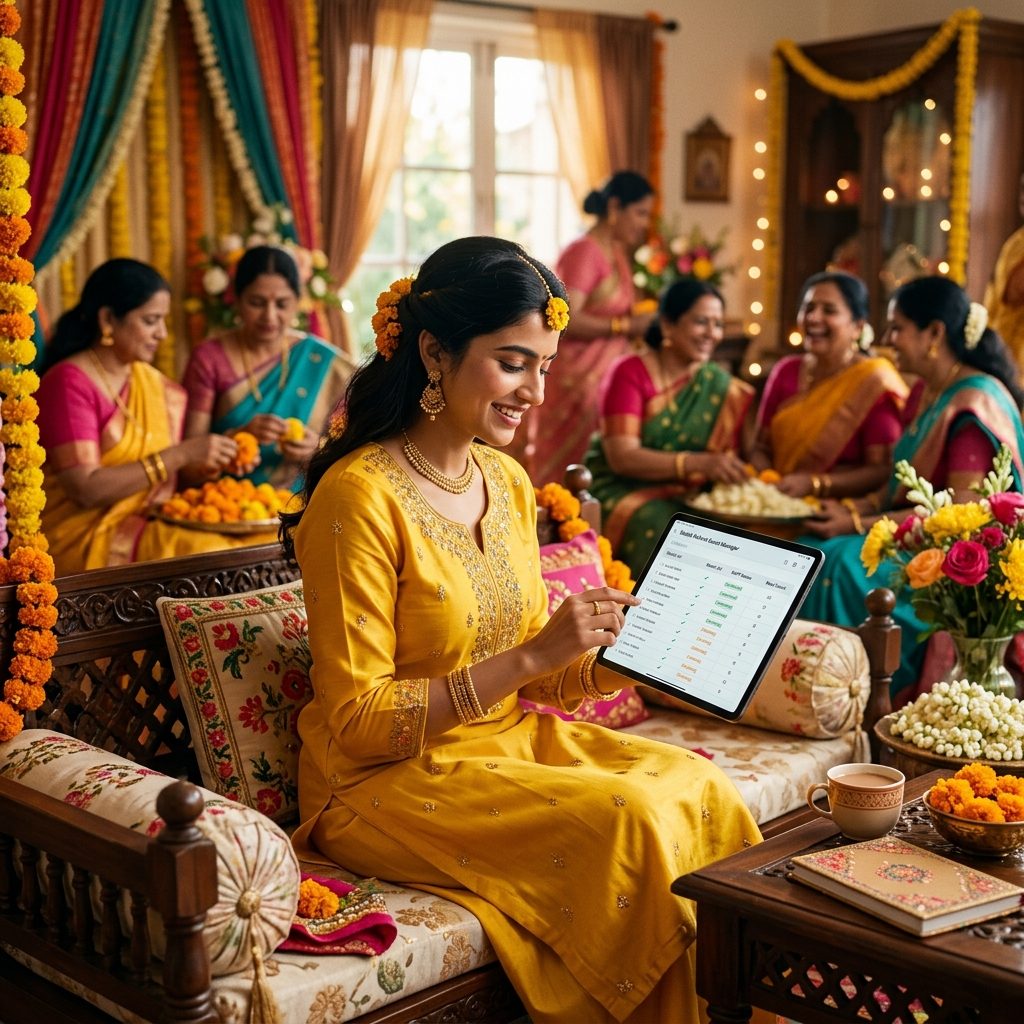
Your wedding guest list is currently spread across six WhatsApp groups, your father's paper diary, and one Excel sheet that three relatives keep editing at the same time. Managing wedding guests digitally is not about being fancy. It is about not crying at 11pm because Mama's three families got counted as one. The moment you move from a spreadsheet to a real wedding guest list manager, the chaos stops fighting back.
Here is the honest truth nobody tells you before the cards go out.
Why does the family spreadsheet always break down?
Short answer: too many cooks, zero version control. One uncle adds his entire colony. Your bua deletes a row by accident. Someone saves a copy named "FINAL_use_this_one_v3" and now there are two truths.
A spreadsheet was never built for an Indian wedding. We do not invite people. We invite families, with plus-ones, with kids, with "haan unko bhi bula lo." A flat list of names cannot hold that. You need to track who confirmed, who is coming for the haldi but not the reception, who is veg, who needs a hotel room, and who quietly RSVP'd no but their mother said yes anyway.
By the time a 400-guest Marwari wedding hits the sangeet, the spreadsheet has 11 colour-coded tabs and one very tired cousin maintaining it. There is a better way.
What does managing wedding guests digitally actually fix?
Short answer: the counting, the confirming, and the chasing.
A proper digital guest manager turns three painful jobs into a few taps. First, the headcount. Instead of guessing, you get a live number that updates the second someone responds, so your caterer gets a real figure and you are not paying for 50 phantom plates. Second, RSVPs. People reply to a link, not to a flooded family group where their "yes" drowns under forwarded good-morning images.
Third, segmentation. You can invite the office crowd to only the reception and the inner circle to every function, without sending one person seven confusing messages. For a Bengali wedding spread across aiburobhat, gaye holud, biye, and bou bhaat, that filtering alone is worth its weight in gold.
You don't have a guest-list problem. You have a guest-list-living-in-four-places problem. Pick one home for it and the panic disappears.
How do digital RSVPs really work for Indian families?
Short answer: a link does the chasing so you don't have to.
This is where most couples freeze. "My nani will never click a link." Fair. But your nani is not the one you are chasing. You are chasing the 80 cousins and colleagues who keep saying "haan haan aa rahe hain" and never confirm a number. For the elders, you still call. For everyone else, the link collects the answer once, cleanly, with their headcount and food preference attached.
The flow is simple. You send the invitation, the guest taps to confirm, the system logs it, and your master list updates itself. No screenshots. No "kitne log aa rahe ho?" forwarded forty times. When you build the actual wedding invitation or video invite, you can attach the RSVP right inside it, so confirming is one tap away from the card itself.
Here is my one honest opinion, and most families get this wrong: stop treating the RSVP as rude. The old logic was "we invited them, asking them to confirm looks like we are doubting them." Meanwhile you over-order food for 600 when 420 show up, and the waste is staggering. A clear digital RSVP is not cold. It is respectful of your own budget and your own sleep.
What should a good wedding guest manager let you do?
Short answer: track, group, and follow up without opening Excel once.
Before you trust any tool, check that it actually handles the way Indian weddings work, not some Pinterest version of them. The non-negotiables:
- Family grouping, not just names - one entry that holds the Sharma family of five, so your headcount is honest from day one.
- Per-function invites - tag who comes for the mehendi, the wedding, the reception, so a Punjabi three-day affair stays sorted.
- Live RSVP status - confirmed, pending, declined, updated in real time instead of you re-counting at midnight.
- Dietary and stay notes - veg, jain, no-onion-garlic, plus who needs accommodation; the caterer and the hotel block both depend on this.
- Easy follow-ups - one tap to nudge everyone still pending, instead of typing the same message thirty times.
- A thank-you tracker - mark who you've thanked after the wedding, so no one gets that awkward "they never even messaged" feeling.
If a tool can do those six things, you have basically replaced your tired cousin, your paper diary, and the cursed spreadsheet in one move.
When should you set this up - and what about the matches before the match?
Short answer: the day you fix even a rough guest count, before the cards are designed.
Couples wait too long. They design the gorgeous invite first, then realise they have no clean list to send it to, and the last week becomes a frantic data-entry marathon. Flip it. Lock the list early, in a place that updates itself, and the rest of the planning leans on something solid.
And if your wedding is still a few steps away - if you are at the stage of meeting people, comparing profiles, sending that first careful message - that is its own digital skill. The same calm, no-spreadsheet logic applies when you are finding compatible profiles and starting a conversation. Get good at managing people digitally now, and the wedding-day version feels familiar instead of frightening.
Start small today. Pull your scattered names into one digital list, group them by family, and let the RSVPs come to you. Managing your wedding guests digitally is the quiet upgrade that lets you actually enjoy your own functions - present at the haldi, dancing at the sangeet, not hunched over a phone recounting heads. Your future, calmer self is already thanking you.