
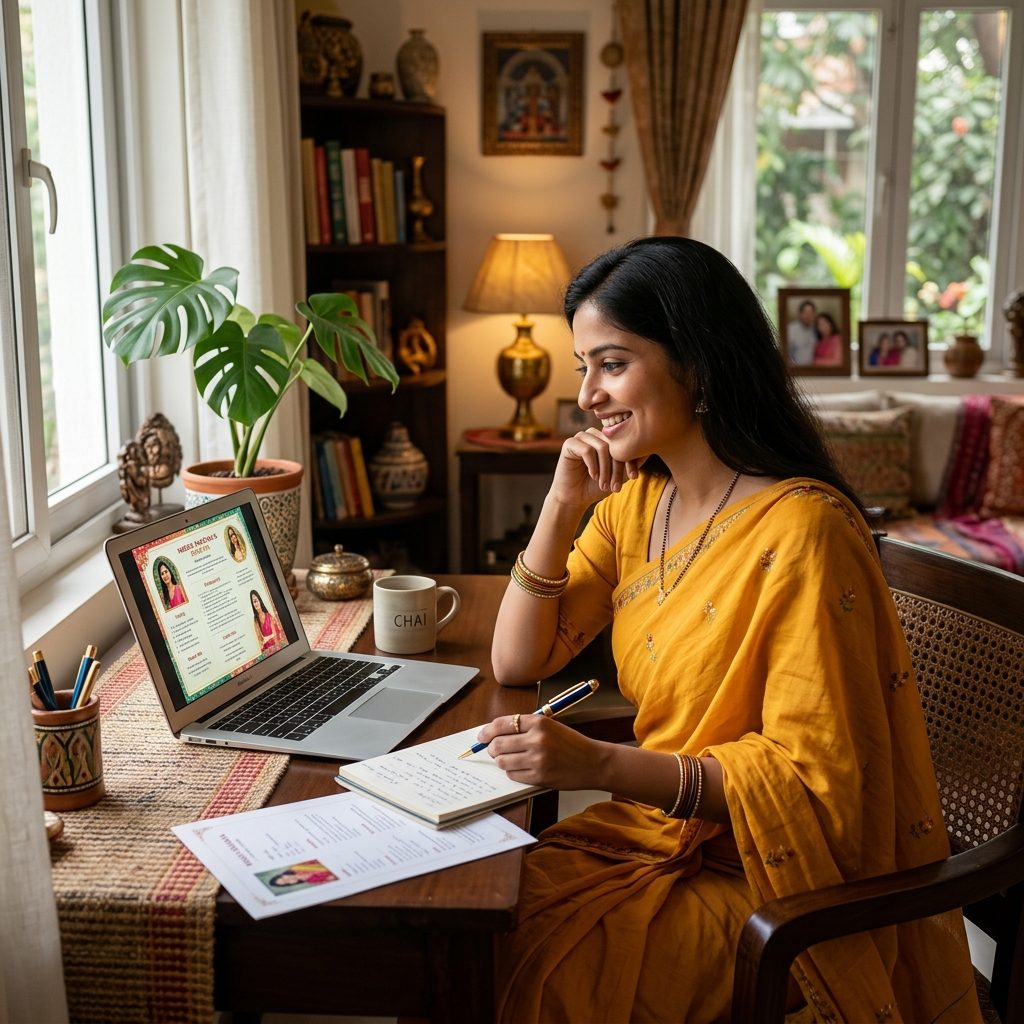
Most marriage biodatas get skipped in about eight seconds. Not because the boy or girl isn't good enough — but because the page reads like a job application written by a tired uncle at 11pm. If you want to learn how to craft the perfect marriage biodata with AI, start here: AI handles the formatting, the symmetry, and the polish, so you can spend your energy on the two or three lines that make a family lean in and say, "Iska number lo." A good biodata isn't a CV. It's a first impression on paper, and now you have a tool that makes the first draft for you.
Let's talk about what actually works — and what quietly kills your proposal before chai is even served.
What makes a marriage biodata get rejected in seconds?
Short answer: clutter and one bad photo. The most common rejection isn't "low salary" or "wrong city." It's a wall of cramped text, a blurry selfie cropped from a Diwali group photo, and a section that lists the family's car and flat like a property brochure. Families scan, they don't read. A Marwari family looking at fifteen profiles a week will pause on the one that's clean, honest, and gives them a face they can picture at the mandap.
The fix is brutal editing. One photo where your eyes are visible and you're smiling like a person, not a passport. Then specifics that mean something — "works in product at a Bangalore startup, sketches on weekends" beats "good nature, family-oriented, simple living" every single time. Those last three words appear on roughly every second biodata in the country, which means they say nothing.
How does AI actually help write a biodata?
Short answer: it removes the grunt work and keeps you honest. You feed in raw details — name, date of birth, gotra, education, what you do, a sentence about your family — and an AI biodata maker turns it into a balanced, properly spaced layout with the religious header symbol your family expects, the right fields in the right order, and language that sounds like a warm human instead of a form. No fighting with Word margins. No photo that's too big on the left and a blank gap on the right.
What it does best is the editing you'd never do yourself. It catches that your "hobbies" line is six words long and your "about me" is a paragraph nobody will finish. It suggests cutting. It rewrites "I am a fun-loving person" into something a stranger can actually believe. And because it generates the structure instantly, you can make a Hindu version with Ganesh at the top, a clean version for a Christian family, or a Tamil Brahmin format with star and rasi — in minutes, not a weekend.
A biodata's job is not to win the marriage. Its job is to win the second conversation — keep it short enough that someone wants one.
What should you actually put in your marriage biodata?
Short answer: enough to feel real, little enough to fit on one page. The non-negotiables are your full name, date and place of birth, height, education, occupation, and contact via a parent or guardian. After that, communities differ — and the differences matter more than people admit.
A South Indian Iyer or Reddy family will look first for the nakshatra, rasi, and gotra, because horoscope matching comes before anything else. A Punjabi Khatri family cares about the same gotra rule for a different reason — to rule out a clash. Bengali families often expect a clear note on whether kundli matching is even required, since plenty of educated Bengali families skip it. A Nair biodata in Kerala may foreground the family's tharavad. Know your audience before you write a word.
- One photo, recent, well-lit. Half-body, plain background, you in clothes you'd wear to meet the family — not a wedding lehenga you borrowed.
- List gotra and nakshatra if your community matches horoscopes. Leaving them out forces an awkward follow-up call and signals you didn't think it through.
- Write your work in plain words. "Senior software engineer, HDFC, Pune" is clear; "working in MNC" makes them assume you're hiding something.
- Keep family details to relationships, not assets. Father's and mother's occupation, siblings, hometown. Skip the BMW and the second floor in Lajpat Nagar.
- Add two real interests. "Plays the tabla, follows Test cricket" gives the other side something to start a conversation with.
- Proofread the spelling of your own gotra and your mother's name. You'd be shocked how often these are wrong, and families notice.
Is an AI biodata too generic to feel personal?
Here's my honest myth-bust, and it's the opposite of what you'd expect: the danger isn't that AI makes you sound robotic — it's that your hand-typed biodata is already the generic one. "Simple family, decent values, looking for an understanding life partner" is the most copy-pasted sentence in Indian matchmaking. AI, used well, pushes you toward the specific. It asks for the detail that makes you you, and a good tool lets you edit every line afterward, so the warmth is yours and only the heavy lifting is automated.
Use it as a first draft, never a final one. Generate the structure, then go back and add the one human sentence — the thing your mother would say about you at a wedding. That line is what turns a tidy document into a proposal someone remembers.
What happens after the biodata is ready?
Short answer: the biodata opens the door, but the match is its own game. Once your page is clean and you're proud to send it, the real work is finding the right families to send it to — people who share your community, your priorities, and roughly your wavelength. Instead of forwarding it blindly on twelve WhatsApp groups, you can put a profile in front of compatible families directly; our Smart Match surfaces profiles that actually fit your background and preferences, so the first conversation starts on solid ground rather than a cold guess.
And when a yes finally arrives and the planning begins, the same instinct that made your biodata clean and warm will make your wedding invitations land too — a thoughtful card or a short video invite from the Invite Studio tells your guests this celebration was made with care, not copied from a template store.
So here's your next step: stop wrestling with margins and tired phrases. Spend twenty minutes to craft the perfect marriage biodata with AI, edit it until one sentence sounds unmistakably like you, pick the one photo where you look approachable, and send it. The right family is scanning fifteen profiles this week. Make yours the one they stop on.