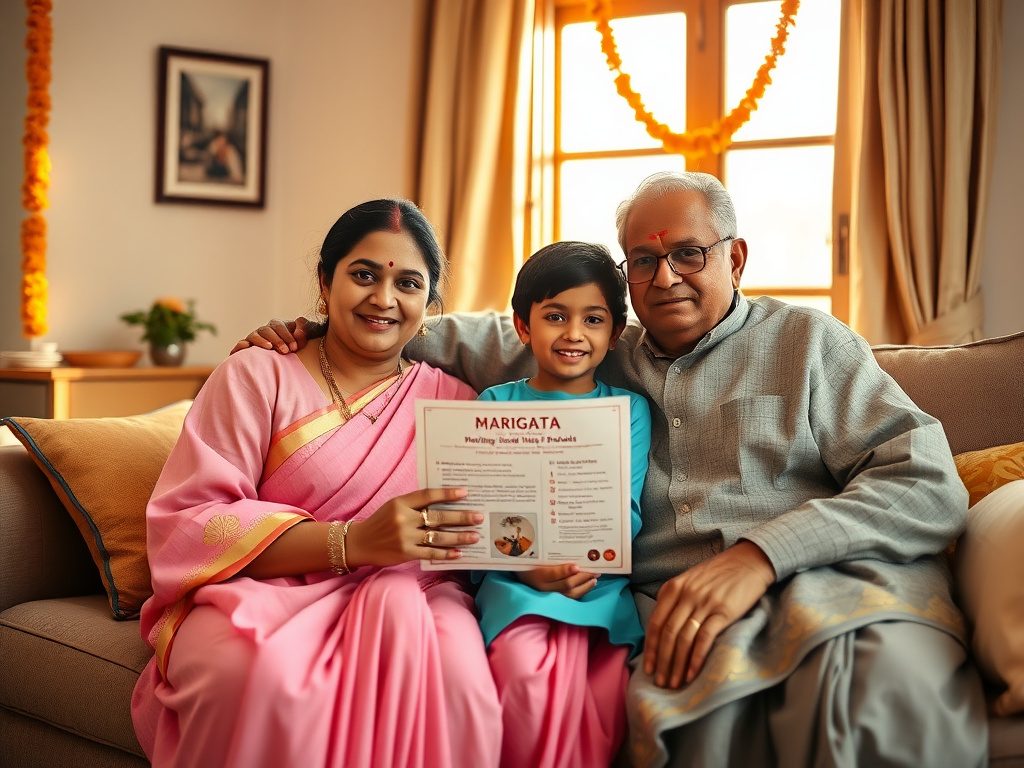
Most families spend nine seconds on a biodata before they swipe to the next one. Nine. A modern Indian marriage biodata isn't a CV and it isn't your mother's two-page Word document with a clip-art Ganesha in the corner. It's a first impression, a filter, and a conversation-starter rolled into one sheet, and getting it right is the difference between "forward this to the Sharmas" and "thoda aur dekhte hain."
So let's build one properly. No filler, no fluff fields nobody reads.
What actually goes on a modern marriage biodata?
Short answer: less than you think, but every line must earn its place. The non-negotiables are name, date and place of birth, height, religion and community, education, profession with a rough income band, and family details. After that, it's about what makes you sound like a person and not a spreadsheet row.
Here's where families get it wrong. They cram in star sign, gotra, manglik status, rashi, nakshatra, complexion, blood group, and the names of three uncles' businesses, then leave zero room for who the candidate actually is. A Tamil Iyer family will reasonably want gotra and nakshatra up top for matching purposes; a Punjabi Khatri family might care far more about the boy's posting city and the girl's career plans. Know your audience. Lead with what their side will scan for first.
A biodata that lists your salary but never your sense of humour tells the other family exactly one thing: that you ran out of things to say.
How long should a marriage biodata be?
One page. Two if your family is large and traditions demand it. The instinct to write three pages because "more detail looks serious" backfires every single time. Long biodatas don't read as thorough, they read as exhausting, and the aunty doing the matchmaking simply won't get to the bottom.
Cut ruthlessly. Your Class 10 percentage does not belong on a marriage biodata in your thirties. Neither does your father's college or the exact pin code of your ancestral village. Keep the family section to parents' occupations, siblings and their marital status, and your native place. That's the information that helps two families place each other socially. Everything else is noise.
If formatting and trimming feel overwhelming, you can put your details into our AI biodata maker and it'll structure everything cleanly, suggest what to keep, and let you pick a template that doesn't look like it was made in 2009. The photo guidance alone saves people from the classic mistakes.
What makes a good biodata photo?
Verdict: one clear, recent, smiling photo beats five filtered ones. Choose a daylight shot, plain or soft background, decent posture, and an outfit you'd actually wear to meet someone's parents. A kurta or a simple saree reads warmer than a stiff suit or a heavily edited selfie.
- Recent and real: a photo from your cousin's wedding two years ago, not your sister's engagement in 2018. Families notice, and it sets a bad tone.
- One face, one frame: no group shots where they have to guess which one is you, and never the cropped-out-ex photo with a stray arm on your shoulder.
- Natural light wins: a window beats a ring light, and a ring light beats a flash. Avoid heavy beauty filters; the in-person meeting has to match.
- Dress like the occasion: festive-Indian or smart-casual. Skip gym selfies, sunglasses, and the car-seat angle.
- One full-length is plenty: many families quietly want to see height and build, so include a single standing photo instead of three more headshots.
How do I write the "about me" without sounding fake?
Be specific, be brief, be honest. "Simple, family-oriented, God-fearing" describes roughly four hundred million Indians and tells the reader nothing. Compare that to: "I'm a paediatric nurse in Pune who cooks Sunday biryani for the whole floor and is genuinely looking for a partner, not a roommate." The second one you remember.
Mention two or three real things: a hobby you actually do, what you want in a partner, and what your week looks like. State your priorities plainly. If you want someone who'll relocate, say so now. If career matters more than an early wedding date, say that too. A biodata that hides the deal-breakers just delays the hard conversation by three meetings.
And this is the one honest opinion I'll plant here: the families that get good matches are the ones that treat the biodata as the start of a relationship, not a marketing brochure. Slightly less polish, slightly more truth, every time.
How does a biodata fit into the bigger matchmaking picture?
The biodata is the handshake, not the wedding. Once it's sharp, the next move is getting it in front of compatible people. That's where browsing genuinely suited profiles matters more than blasting your sheet to fifty groups. You can explore compatible profiles on Smart Match where the matching is done on what you've actually written, religion, community, age and preferences, instead of pure luck on a WhatsApp forward.
From there the rhythm is familiar: a respectful first message, a horoscope check if your families want one, a meeting, then the longer conversations. And when things move forward and you reach the happy chaos of fixing dates, our wedding invitation studio turns the same details into e-cards and video invites without a single trip to the printer. But that's a joyful problem for later. First, the biodata.
Build it once, build it honestly, and keep it to a page. A clean, modern Indian marriage biodata won't get you married by Tuesday, but it'll make sure the right family stops scrolling long enough to actually see you. So open a fresh sheet today, fill in the real you, pick a template you'd be proud to forward, and send it out. The rest is conversation.