
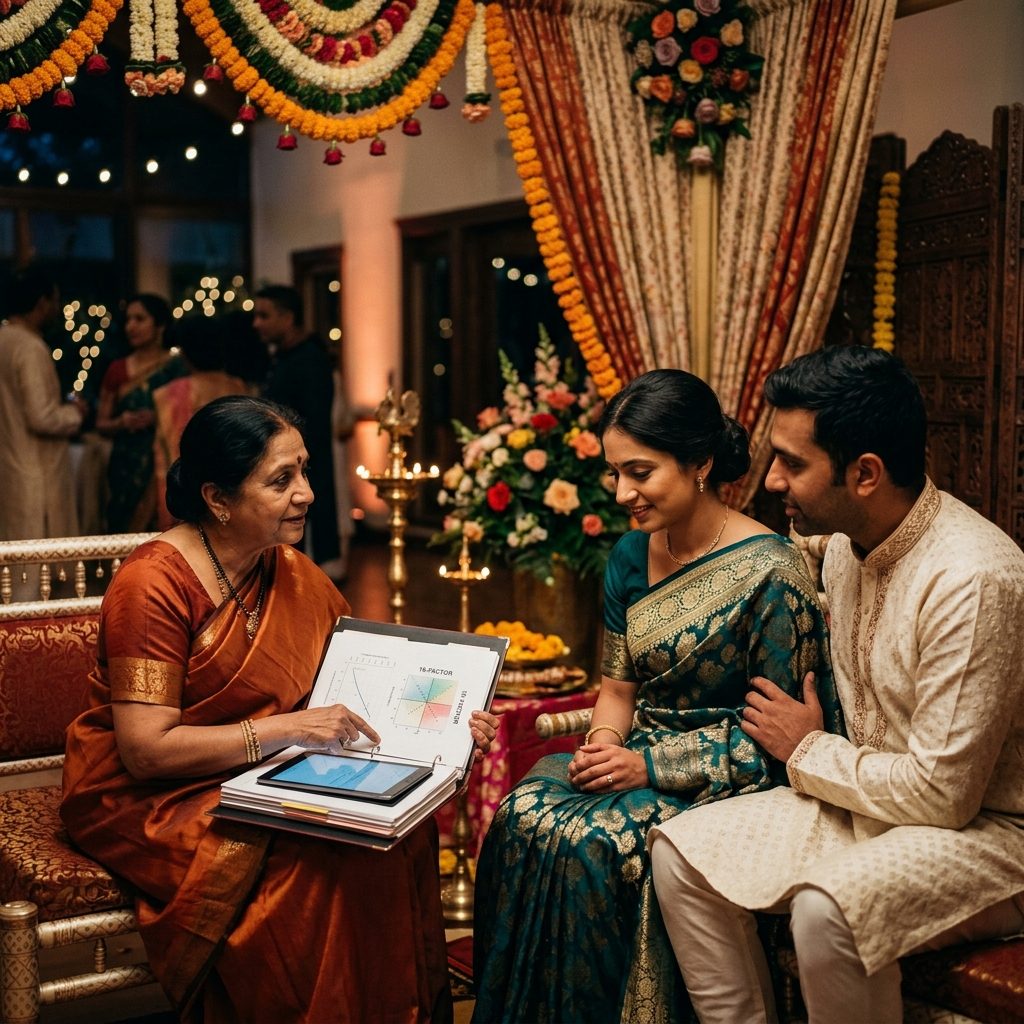
Two profiles can match perfectly on age, city, height, and salary, and the marriage can still fall apart in eighteen months. That is the dirty secret nobody tells you. Real 18-factor matchmaking looks past the obvious filters families fixate on and weighs the things that actually decide whether two people can share a kitchen, a budget, and a Sunday morning for the next forty years.
Your parents shortlist on three things: caste, income, and "good family." Useful, sure. But a 28-year-old Bengaluru engineer and a 26-year-old Bengaluru engineer can tick every box and discover on the honeymoon that one wants to move to Canada and the other will never leave their aging parents. Same city. Opposite lives.
Why do age and city tell you almost nothing about compatibility?
Short answer: because they are sorting filters, not matching factors. Age narrows the list. City narrows the list. Neither of them predicts whether you will be happy.
Think about it honestly. "Same city" feels safe, but a Marwari business family in Jaipur and a salaried Bengali household in the same city can have completely different rhythms around money, festivals, and who hosts whom. Age within two years feels balanced, yet a person's life stage matters far more than the number, one 30-year-old may be ready to settle and parent within a year, another is still figuring out their career. Filters reduce noise. They do not find the signal.
So what are the 18 factors that actually matter?
They cluster into six honest buckets, and good matchmaking scores all of them, not just the first one.
- Values and beliefs: religious practice (how observant, not just which religion), spiritual outlook, and stance on rituals like a Satyanarayan puja or keeping Karva Chauth.
- Family architecture: joint vs nuclear expectations, where you will live after marriage, and how involved both sets of parents will be.
- Money mindset: saver vs spender, attitude to loans and EMIs, and who manages the household budget.
- Lifestyle and habits: diet (pure veg, Jain, eggetarian, non-veg), drinking, sleep cycles, fitness, and the introvert-extrovert gap that quietly wrecks weekends.
- Ambition and mobility: career drive, openness to relocating, NRI vs India settlement, and whether both partners want to keep working.
- Personal chemistry: communication style, conflict handling, sense of humour, and the want-kids question that too many couples postpone until it is a fight.
Count them properly across those buckets and you land around eighteen real variables. A modern Smart Match tool that ranks compatible profiles weighs all of them at once and surfaces the people who fit how you actually live, not just how you look on paper, so your first message goes to someone genuinely worth talking to.
Where does kundli and guna milan fit into all this?
Short answer: as one powerful layer, not the whole verdict. For most Hindu families, horoscope compatibility is non-negotiable, and rightly so when it is read with sense.
An Iyer family will care deeply about nakshatra and rashi alignment. A Punjabi Khatri family might check Manglik dosha and little else. The 36-point Ashtakoot or guna milan system measures eight traditional koots, mental wavelength, temperament, health, progeny. It maps surprisingly well onto the psychological factors above. The trick is to treat a guna milan and kundli compatibility check as a meaningful signal alongside the human ones, not as a single number that overrides everything you can see with your own eyes.
A 36/36 score with zero shared values is a beautiful chart attached to a difficult marriage. Compatibility you can live with beats compatibility you can only frame.
What do most families get wrong about "compatible"?
Here is my one honest opinion, and it is unpopular at the dinner table. Families chase sameness when they should be checking fit.
Sameness says: same community, same income bracket, same city, done. Fit asks the harder questions, do these two people resolve a disagreement the same way, do they want the same shape of life in ten years. A Nair doctor and a Reddy doctor are not automatically compatible because both are doctors and both are South Indian. Meanwhile a saver and a spender can absolutely thrive if they talk about money openly, the problem is never the difference, it is the silence around it. Stop optimising for a resume. Start optimising for a roommate, a co-parent, a teammate.
How do you actually use 18-factor matching without overthinking it?
Short answer: be ruthlessly honest on your own profile first, then let the weighting do the work.
The single biggest reason matching fails is dishonest inputs. People write "adjusting" when they mean "I expect my partner to adjust." They tick "open to relocate" to widen their options, then refuse every Mumbai match. Garbage in, heartbreak out. Fill your marriage biodata the way you would brief a trusted family elder, accurate on diet, family setup, work, and what you genuinely will and will not compromise on. The honest profile gets fewer matches and far better ones.
And give real weight to the things you cannot fix later. You can grow to love a different city. You cannot retrofit shared values onto a person who fundamentally wants a different life. Weight values, family expectations, and the kids question heavily. Weight height, hobbies, and "same college" lightly. That ordering alone will save you a dozen pointless conversations.
None of this kills the magic of an Indian wedding, the haldi, the sangeet, the chaos of cousins. It just means the two people at the centre of it are actually built to last. Start with an honest profile, lean on real 18-factor matchmaking instead of three lazy filters, and judge fit over sameness. Do that, and the match you find will still be standing long after the mehndi has faded.